# Body Tracing Framework

This article organizes reels, weaves, windmills, crossers, waist wraps, and meltdowns into a single framework based on position and timing, using an extensive system of schemes and beat graphs. The Body Tracing Framework is designed for poi, but will also be useful for many other flow arts props.

{% hint style="success" %}
Support the Project — [Get the Merch](https://antispinner-store.myshopify.com/)
{% endhint %}

{% hint style="info" %}
**Published online**

* Russian original: May 2024 (PDF in [Downloads](/btf/resources/downloads.md)).
* English version: Apr 2026.

This work was written without the use of AI, except for translation into English.
{% endhint %}

## Introduction

At this point, the number of poi tricks has grown so large that it is impossible for one person to learn them all. With limited resources, every poi spinner increasingly faces the challenge of finding the most effective learning program.

Each trick provides us with a certain skill of varying value. Learning some opens the door to multiple variations, while others pave the way for entire categories with dozens of families and hundreds of tricks. To acquire the maximum amount of skill in the shortest time, it is essential to understand which moves are the most valuable. Classification helps us with this understanding.

Modern poi classification is somewhat spontaneous, consisting of separate groups of tricks and families that are connected only conditionally. To systematize knowledge, we attempt to find links between the tricks we know. However, new families and even entire categories emerge every year, overturning our previous understanding. To build a clear structure, one would need to see all the "pieces" at once, which is simply impossible.

In this work, I would like to demonstrate an alternative approach. Instead of searching for connections between the tricks we already know, I will attempt to present a unified principle of constructing all moves, to see the system as a whole, including not only the moves we know but also those yet to be discovered.

This work is based on the fairly widespread hypothesis that any trick can be viewed as a combination of simpler elements, and at the most fundamental level, all tricks consist of a limited number of the same conditionally indivisible "building blocks." This work is dedicated to what these "building blocks" might be and how they are assembled into moves.

Attempting to create such a deep classification for all poi would be too ambitious of a task, so I have focused my research on the narrow scope of one specific direction—body tracing in a wall plane configuration of planes—and only one main method of poi manipulation: spinning, without pendulums, rolls, or tosses. As you will see, even this is enough to once again convince us of the endless possibilities that poi offers.

Due to the complexity and depth of the research, this work will be more interesting to advanced poi spinners to identify areas for growth, and to experienced instructors for creating the most balanced body tracing training programs.

{% hint style="info" icon="dove" %}
This work was written independently of any research by other authors. However, I cannot fail to mention a video by [Leo Icaza](https://www.youtube.com/watch?v=GMy-0_9m-5A), which I watched shortly before publishing this document. In it, the author presents the same idea that became the foundation of my research. I express my respect for my colleague and am genuinely glad that I was able not only to reach the same conclusions but also to develop them into something more.
{% endhint %}

#### Research area

All body tracing moves can be divided into several body zones where they are performed: the torso, head, arms, and legs (Fig. 1). This research focuses only on the central torso zone, which includes all areas below and above the shoulders (including behind the back) and the trajectories between them. By distinguishing the area above the head into a separate zone, the torso zone forms a fully symmetrical cross shape. Therefore, I will refer to it as the "body cross" in the following sections.

<figure><img src="/files/zVm0eN1RLATJ874ltEgN" alt="" width="375"><figcaption><p>Fig. 1. Body zoning in body tracing</p></figcaption></figure>

#### Systematization principle

All moves consist of a limited set of unique parts, like building blocks, from which we can construct anything. Based on this, we can describe only these fundamental "proto-elements" and the principles of combining them into basic combinations. This allows any complex move to be viewed as a combination of previously described components.

In the system I propose, all poi trajectories within the body cross zone can be divided into uniform segments of trajectories connecting the front and back planes—reels (Fig. 2). In other words, any move within the body cross can be represented as combinations of reels in different positions. This term is not highly specific, so let’s break it down from the basics.

<figure><img src="/files/Wl7zIRBhoMA42ZRKkpRf" alt="Reel trajectory between front and back planes (infinity shape)" width="375"><figcaption><p>Fig. 2. Reel trajectory</p></figcaption></figure>

A reel is a cyclical movement in a wall plane configuration where the poi continuously moves back and forth between the front and back planes, making one rotation in each plane, and from the poi spinner's perspective, drawing a figure resembling an infinity symbol. Put simply, a reel can be described as a single-poi weave.

The simplest combination of two reels, one with each hand, is a two-beat weave. It's important to note that when combining two reels, we can obtain combinations with different directions and timings. This means that in this work, a two-beat weave is not necessarily a same-direction move, as is traditionally classified.

{% hint style="info" %}
In addition to two-beat weaves, there are three-beat, five-beat, and even seven-beat weaves. However, following the proposed logic, any of these can be viewed as combinations of two-beat weaves and empty rotations without changing planes. Therefore, in this work, we will focus only on two-beat weaves as the most fundamental form within the family of weaves.
{% endhint %}

In summary, all moves within the body cross zone can be represented as combinations consisting of a single proto-element performed with a single poi—the reel in various positions and directions. The simplest combination of two reels is the two-beat weave. Now, let’s dive deeper into analyzing reels and explore the different positions in which we can perform them.

## Reels

### Positioning of reels

#### Introduction to graphic positioning diagrams

In the body cross, there are only 4 areas where you can perform reels: two above the shoulders and two below the shoulders. In these 4 areas, each hand can occupy 6 unique positions (Fig. 3):

* **High native** – above its own shoulder
* **Low native** – below its own shoulder
* **High non-native** – above the opposite shoulder
* **Low non-native** – below the opposite shoulder
* **High back** – Behind the head
* **Low back** – Behind the back

<figure><img src="/files/Ek2zkunqlhx3nZhoSOSM" alt="Hand positions in the body cross and their notation symbols" width="375"><figcaption><p>Fig. 3. Variations of hand positions in the body cross<br>and their notations in the graphical positioning system</p></figcaption></figure>

Any other positions for weaves within the body cross zone can be considered simply alternative forms of the ones listed above. For example, the positions under the armpit and at the hip are in the same area, and the difference between them doesn’t affect the principle of the move—only its visual form.

To further explore the variety of combinations of these reel positions for both hands, we will convert our analysis into a graphical notation system—positioning diagrams.

We will depict the body cross zone as a cross, with the arms' positions marked between its arms, using three symbols to indicate position:

* **⭘** — same side,
* ╋ — opposite side in front of the body,
* ━ — opposite side behind the back/head.

Thus, the notation for all possible positions of the right hand will look as shown in the diagram (Fig. 3). All possible positions for the left hand are recorded in the same way, but mirrored from left to right.

{% hint style="info" %}
This notation system allows us to distinguish between the left and right hand without color differentiation. However, for easier perception in this research, we will mark the left hand in blue and the right hand in pink.
{% endhint %}

#### Two-handed positions

Knowing all the possible positions of each hand, we can create a matrix of positioning options for both hands by placing the positions of the right hand horizontally and the left hand vertically, grouping similar combinations together (Fig. 4). It becomes clear that all the groups along the diagonal from the top left corner are completely symmetrical, while the other groups have asymmetrical positions with mirrored "twins" on the other side of the diagonal. These paired groups are highlighted in the same color on the diagram.

<figure><img src="/files/HA8jtud7XAlQabaXvmsY" alt="Matrix of two-handed reel positions (36 combinations)"><figcaption><p>Fig. 4. Positioning matrix of reels</p></figcaption></figure>

As a result, we obtain 36 possible positions where reels can be performed. Each group in this diagram represents a small "family" of simple reel combinations. Let’s try listing them, analyzing, and giving names to the unnamed ones.

We can immediately identify a primary trend in the division of hand positions—those where the hands are on the same side of the body (left or right) and those where they are on different sides. As we will see later, there is a fundamental difference in how these positions function, so we will initially divide them into classic weaves, performed on the same side, and mills, performed on opposite sides.

Let’s look at each group in more detail (Fig. 5):

**MILLS:**

* **Common Mills** — classic mills above and below the shoulders, as well as mixed types.
* **Crossers** — the crosser, which in this system is considered a mill with hands on non-native sides. The familiar crosser is closest to the mixed type.
* **Back crossers** — a crosser behind the back, behind the head, or a mixed type combining both positions.
* **D-crossers** (double-sided crosser) — a two-sided crosser where one hand is behind the back, and the other is in front.

**WEAVES:**

* **Weave** — a weave above/below the shoulders and mixed types.
* **Back weave** — weaves behind the back, behind the head, and their mixed forms.

Thus, we have identified all the possible hand positions where reels can be performed within the body cross. Next, we will explore how these combinations can work in terms of timing and the poi directions relative to each other.

<figure><img src="/files/uByyADG1EW8pPS8bKexd" alt="Summary of reel families: mills, crossers, weaves, and back variants"><figcaption><p>Fig. 5. Summary table of reels</p></figcaption></figure>

### Timing of reels

#### Introduction to the beat graph method

To study different timing types, I propose the beat graph method, which requires separate exploration. Understanding how we can describe all timing types in any complex move will be facilitated by analyzing the fundamental types of poi timing. By simply spinning two poi in a static hand position, we can achieve different combinations by changing two parameters: the poi directions and their timing relative to each other. Changing the poi directions allows us to have either same-direction rotation or opposite rotation. Timing works more specifically. As both poi spin, we can shift the cycle of one of them in time, resulting in different timing types. The determining factor in the number of timing types is the step by which the cycle is shifted. In poi timing, as in all moves, with the exception of some very specific trick categories, one step is half a poi rotation (or half a beat, if using a rhythmic term).

When considering the simple rotation of a poi in a static hand position, a full cycle of its movement consists of one rotation, which includes two half beats. We can construct a time-axis graph based on this information, conditionally describing the poi’s movement from the top position (first half beat) to the bottom (second half beat) and back (Fig. 6).

<figure><img src="/files/R7SyJZSdFT9OXgFuAC99" alt="Beat graph of one poi rotation in a circle (two half beats)" width="563"><figcaption><p>Fig. 6. Beat graph of poi movement in a circle</p></figcaption></figure>

{% hint style="info" %}
In such a side projection, the exact movement graph of the poi should resemble a sine wave, where at the top and bottom points, the poi crosses the beat reference point. However, for visual simplicity, from here on, we will connect the beat points with straight lines.
{% endhint %}

The resulting beat graph will be identical for both poi. Therefore, if we start both poi from the same position, the graphs will overlap, perfectly mirroring each other—this is called Together Time timing, with the beat graphs aligning one-to-one (1/1) (Fig. 7).

<figure><img src="/files/7AwcfPtSKiZZUa41xNJp" alt="Together Time beat graphs (1/1) for two poi in a circle" width="563"><figcaption><p>Fig. 7. Beat graph of synchronous movement of two poi in a circle</p></figcaption></figure>

Next, we can shift the starting point of the second poi by one step, with one poi starting from the top position and the other from the bottom. In this case, the graphs will be completely opposite to each other—this is called Split Time timing, with the beat graphs offset by half of the poi’s full movement cycle (1/2) (Fig. 8).

<figure><img src="/files/ES6YKKQFDdKZZ3uHqfTj" alt="Split Time beat graphs (1/2) for two poi in a circle" width="563"><figcaption><p>Fig. 8. Beat graph of asynchronous movement of two poi in a circle</p></figcaption></figure>

Since there are only two half beats in a full cycle, further shifting the second poi's graph will complete the cycle and return it to the starting position. Thus, we can clearly see that for single-beat poi movements, there are only two timing types:

* **Together Time** — both poi pass each beat reference point at the same time (example: synchronous butterfly).
* **Split Time** — both poi pass opposite beat reference points at the same time (example: asynchronous butterfly).

It is important to understand that timing is not inherently related to direction. Here and beyond, we will see that any timing type can be performed with both same-direction and opposite-direction poi movement:

* **Same direction** — both poi move in the same direction.
* **Opposite direction** — the poi move in opposite directions.

Thus, there are four timing/direction combinations, which we will abbreviate for convenience:

* **TS** — Together Time / Same direction
* **SS** — Split Time / Same direction
* **TO** — Together Time / Opposite direction
* **SO** — Split Time / Opposite direction

{% hint style="info" %}
In this work, I use the term "Together Time" instead of the more familiar "Same Time" for ease of use in abbreviations. The words "Same" and "Split" begin with the same letter, making them inconvenient to abbreviate.
{% endhint %}

#### Beat graphs of reels in wall plane projection

Having understood the principles of beat graphs, let’s change their appearance, adapting them to examine reels in the wall plane configuration. First, let’s take a close look at the trajectory diagram of a reel (Fig. 9). The poi makes one full circle in front and one behind. In each circle, the poi passes two reference points for half beats (the positions at the bottom and top of the circle). The point where the poi transitions from one plane to the other is called the transition point.

<figure><img src="/files/KaMTdbOFXKpZ43qYEsw8" alt="" width="563"><figcaption><p>Fig. 9. Reel below and above the shoulder in wall plane projection</p></figcaption></figure>

Let’s create the clearest possible projection of the body onto a beat graph using the example of a reel performed with the right hand under its own shoulder. Imagine we are looking at the poi spinner from behind and change the orientation of the beat graph to vertical, allowing us to move along the time axis from top to bottom (Fig. 10).

<figure><img src="/files/zZ1ypnGfTgmkKZTA6sVb" alt="" width="280"><figcaption><p>Fig. 10. Beat graph of a reel with a single poi<br>in wall plane projection</p></figcaption></figure>

To separate the front plane and back plane rotations onto different axes, we will depict the poi’s circular trajectories as different-sized circles. This way, the two half beats in the front plane are on the central axis, and the other two half beats are in the back plane on the side axis. We will label the side axes with the letter L (low—position under the shoulder) in the colors corresponding to the sides.

In the graph, you can see that both steps on each side fall on the same axis, meaning they are indistinguishable from one another—just by looking at the graph, we cannot tell whether the poi is at the top or bottom in a specific point. If we spin the poi in the opposite direction, the graph will remain the same. This is one of the limitations of the graphs, but it reflects the real meaning of timing—the timing types are not connected to the poi’s direction, so direction does not matter when considering them.

By simply moving the graph of the right hand to the left side, we get the graph of a reel performed with the right hand on the opposite (left) side. Similarly, by adding the graph for the left hand on its own side, we can depict the graph of a two-beat weave on the left side, and by shifting one of the graphs (the right-hand one), we can create four timing types for the weave (Fig. 11). Anticipating the next step, let’s also add the H axes (high—position above the shoulder), which we will refer to later.

<figure><img src="/files/Hf5M9JiVwQiRYoq71ZU0" alt=""><figcaption><p>Fig. 11. Beat graphs of four timing types for the lower weave on the left</p></figcaption></figure>

From the resulting graphs, it is immediately clear that two timing types are unique in form (the first and third), while the other two are mirror copies of each other. This pattern is typical for any movements involving more than two beats. In theory, mirrored copies are unique timing types, but in practice, they are moves with the same principle but different leading hands.

Let’s examine each type in detail:

* **Unison weave** (uni-weave) — the hand movements are completely identical in phase (1/1)—the poi move between planes at the same time, together in the front and together in the back plane.
* **Chasing weave** — a type of hand timing known from the classic two-beat weave, where one poi leads and changes sides first, and the second poi follows with a delay of half a beat. This timing type is asymmetrical, meaning it has a mirrored copy with the leading hand reversed (1/4, 3/4).
* **Counter weave** — a timing type with the graphs offset by half of a full cycle (2/4)—one full rotation. The poi switch sides at the same time, but move toward each other, never on the same side simultaneously.

These are the three possible timing types for two-beat weaves and mills. Each timing type can be performed with both same-direction poi movement and opposite-direction movement, but only in one timing type for each direction combination. The possible timing/direction combinations are distributed as follows:

* **Unison weave —** **TS, SO** (Together Time / Same direction, Split Time / Opposite direction)
* **Chasing weave —** **SS, TO** (Split Time / Same direction, Together Time / Opposite direction)
* **Counter weave —** **TS, SO** (Together Time / Same direction, Split Time / Opposite direction)

In the graph above and below each, the abbreviations for the poi directions and timings with which the move can be performed are listed.

<figure><img src="/files/L6Qj6B6U8SlGSESujST8" alt=""><figcaption><p>Fig. 12. Beat graphs of the lower mill</p></figcaption></figure>

In a similar way, we can construct graphs of mill timings by simply depicting each hand’s graph on its respective side (Fig. 12).

The number and types of timings remain the same; however, it is worth noting that when transferred to the opposite side, the graph is mirrored horizontally, meaning the appearance of some timings can change to the exact opposite. For example, the graph of a uni-weave deceptively resembles the graph of a counter mill.

When the hands are positioned on opposite sides of the body, the mapping between hand timings and timing/direction combinations changes as follows:

* **Unison mill — SS, TO**
* **Chasing mill — TS, SO**
* **Counter mill — SS, TO**

{% hint style="info" %}
The distribution of timing/direction combinations is related to the position of the transition points in the reels. This entire study is based on the transition points being located on the same horizontal line with the center of rotation. When the transition point shifts to a vertical line, it becomes possible to perform moves with different timing/direction combinations, but in practice, spinning the poi close to the body with a vertically aligned transition point (either above or below) is clearly inconvenient. This is likely due to the vertical orientation of our body, where a vertical transition point brings it too close, increasing the risk of collision. This hypothesis is supported by the fact that mills above the head, where nothing obstructs movement, can be performed with a vertical transition point without any problems, unlike mills at hip level.

Nonetheless, in this study, we do not consider the point above the head, so such transition point positions are not taken into account, and the described timing distribution remains unchanged.
{% endhint %}

The described beat graph method allows us to visualize any variations of mills and weaves in all positions. To explore ways of visualizing them, let’s take a top-down view of a reel (Fig. 13). The graph of reels performed on the same side, or in front on the opposite side, is depicted as a solid line in the color corresponding to the hand, drawn between the central axis and the side axes "L" for the under-shoulder position (1,2) and "H" for the above-shoulder position (4,5). Reels performed behind the back or head are depicted with dashed lines between the central axis and the "L" axis for the behind-back position (3) and the "H" axis for the behind-head position (6).

<figure><img src="/files/u2DcAIlmXoGvPayLzw7s" alt="Beat graph notation for reels in six positions (front/back, high/low)" width="563"><figcaption><p>Fig. 13. Graphs of reels in 6 possible positions</p></figcaption></figure>

For easier understanding of this graphical system, you can imagine the person from a top-down perspective, with the axes of the upper positions, which are closer to the viewpoint, appearing wider on the outside, and the more distant lower axes closer to the center inside (Fig. 14).

<figure><img src="/files/Ms6e6pD7rHtUFomq6y08" alt="" width="375"><figcaption><p>Fig. 14. Visualization option for beat graph axes</p></figcaption></figure>

Here are several examples of different reel combinations shown on beat graphs (Fig. 15):

<figure><img src="/files/CmKopNMGueWo6Qn8vP9q" alt="" width="563"><figcaption><p>Fig. 15. Examples of beat graph diagrams for different weaves and mills</p></figcaption></figure>

#### The value and purpose of beat graphs

Before moving on to the next section, I would like to say a few more words about beat graphs. Their wide range of capabilities allows us to depict very complex moves; however, they require considerable skill to read. Anticipating potential criticism of this tool, I want to highlight its main purpose and value.

Beat graphs, first and foremost, provide a visual way to identify all possible timing variants of moves of any length. More importantly, they allow us to translate these timing variants from “paper” into practice. Many of the moves described in this work were not known before the application of beat graphs, and discovering them purely through imagination, without a clear notation system, would have been extremely difficult.

No matter how complex and difficult a graph may seem, remember that it is not meant to be a day-to-day tool requiring quick reading. Instead, it is a research method, needed only in the process of discovering new moves and transferring them from "paper" to practical execution.<br>

### The form of weaves and mills

We have theoretically explored where and which types of weaves and mills can be performed, but when we place two hands spinning poi in the same zone close to each other, practical questions arise about their positioning in a limited space.

For example, when performing a same-direction counter weave, we can place either hand on top without changing the timing type or the weave positioning. These variations in hand positioning within the same space and timing are referred to as the “form” of a move.

In some cases, the form of the move can be determined by the chosen way of layering the planes within the move. A simple example outside the scope of this system is the positioning of planes in a synchronous butterfly—either the right poi or the left poi can pass closer to the viewer in the upper part of the butterfly. Rearranging the planes does not affect the mechanics of the butterfly, but it changes its layering.

In this work, layering has the greatest impact on unison weaves performed in the same zone, such as under the shoulder. In these moves, the poi are simultaneously in the same plane, making the question of distributing them into different layers more relevant. As a result, the number of different forms of the same weave, while maintaining timing and positioning, can reach up to four.

The topic of layering is too broad to cover in this work, so we have noted the presence of possible variations in the forms of individual moves and leave the detailed analysis of this topic for future research.

### Section summary

* Practically all spinning moves within the body cross zone can be broken down into reels in various positions and empty rotations.
* In the body cross, there are 36 positions for two hands where reels can be performed.\
  Reels with both hands form weaves or mills.
* Any weave or mill can be performed in one of three timing types: unison, chasing, or counter.
* There are a total of 4 timing/direction combinations. Each timing type for weaves and mills can be performed in two timing/direction combinations.
* In practice, in some weaves and mills, the hands can occupy different positions within the same zone and timing, creating different “forms” of the move.

## The principle of combining reels

One might assume that by mastering all the timings of weaves and mills in all positions, one could gain a comprehensive skill set for learning any trick. While this is close to the truth, it’s not entirely accurate. The way we combine reels and make transitions between them is also a crucial skill that requires separate study. Therefore, we will now explore the main ways to combine reels, which will be divided into double and triple combinations, consisting of two and three reels, respectively.

Let’s take another look at the reels from above (Fig. 16).

<figure><img src="/files/scF8dPzIqmTgO3dIWKDn" alt="Three levels of reel combinations: reel, wrap, and cosmo" width="375"><figcaption><p>Fig. 16. Three levels of reel combinations</p></figcaption></figure>

A combination of two reels on two sides, performed with both hands, already has a familiar name—waist wrap. We will remove the reference to a specific body part and simply use the term wrap as a universal name for a direct combination of two adjacent reels without any extra rotations.

In the diagram of a combination of three reels in one sequence, we see the familiar trajectory of the arm in the cosmo move. In most of the world, cosmo is known as meltdown, but I will use the familiar term cosmo, as proposed by the Japanese, because it is simpler and more concise.

Next, we will examine wraps and cosmo in more detail.

## Wraps

Using the now familiar term wrap, we will have to slightly alter its meaning. Typically, the term "waist wrap" refers to combinations of any two weaves on different sides, most often two-beat or three-beat weaves. We do not consider three-beat weaves in this study, as they are essentially more complex combinations of two-beat weaves and empty rotations. However, even with two-beat weaves, things are not that simple.

In the classic waist wrap based on two-beat weaves, there is an additional empty rotation in one of the transitions from one side to the other, needed only to bring the correct hand forward. This extra rotation is required only in one timing/direction combination (Split Same), so this wrap can confidently be considered a specific case—a more complex combination, rather than a fundamental move.

Thus, the familiar waist wraps do not fit into this system—we will need to take a step back and redefine how we understand the term "wrap."

Let’s examine the poi trajectory when adjacent reels are combined into a single action without any extra rotations (Fig. 17). We get a looping trajectory lasting three beats (6 steps) without empty rotations, where the circle in the front plane is shared by both reels. It is these moves, where the poi make such a loop, that we will refer to as wraps.

<figure><img src="/files/UQsaMAUZbR8XDckhRymk" alt="Conditional trajectory of one poi in a wrap (two adjacent reels, loop shape)" width="375"><figcaption><p>Fig. 17. Conditional trajectory of one poi in a wrap<br>(The back rotations are drawn smaller for clarity)</p></figcaption></figure>

### Positioning of wraps

Following the familiar method of graphic positioning diagrams, let’s describe all possible combinations of two adjacent reels for a single poi. From the six reel positions that can be performed with a single poi, eight pairs are possible (Fig. 18). Other double combinations are either impossible due to joint limitations or require transitions with additional rotations.

<figure><img src="/files/zo2Ia8jlsa93kJhJ5dlg" alt="" width="375"><figcaption><p>Fig. 18. Variations of wrap positions with a single poi</p></figcaption></figure>

Based on the principles we know, let’s create a positioning matrix by grouping symmetrical combinations by similarity (Fig. 19). As with weaves, we see a pair of semi-asymmetrical "mirror" groups, which represent one type of move in two mirrored versions.

<figure><img src="/files/KedPNBb5KZdKRuvvZRwR" alt="Positioning matrix of wraps with similarity groups highlighted"><figcaption><p>Fig. 19. Positioning matrix of wraps with similarity groups highlighted</p></figcaption></figure>

{% hint style="info" %}
Upon closer examination, we can see that most combinations are asymmetrical. From an efficiency standpoint in learning, any asymmetrical wraps can be viewed as combinations of two vertical halves of symmetrical wraps. For example, symmetrical wraps (let's call them AA and BB) can combine their halves to create asymmetrical wraps (AB and BA, respectively) (Fig. 20).
{% endhint %}

<figure><img src="/files/sFxj7ZycPN4rq6dYn8p6" alt="Constructing asymmetrical wraps by combining halves of symmetrical wraps" width="563"><figcaption><p>Fig. 20. Example of constructing asymmetrical wraps<br>by combining halves of symmetrical ones</p></figcaption></figure>

{% hint style="info" %}
Thus, we can assume that mastering all symmetrical wraps will provide the most comprehensive skill set. Therefore, asymmetrical combinations may be considered secondary in the system and not necessary for primary learning.
{% endhint %}

Let’s list the resulting wrap groups in a table and give them names for further analysis (Fig. 21).

<figure><img src="/files/CgGXRzZoXZnxdQqxmAkg" alt=""><figcaption><p>Fig. 21. Summary table of wraps</p></figcaption></figure>

Let’s take a closer look at each group of wraps:

* **Vertical wraps** — Vertical wraps are among the most obvious and, at the same time, the most distinctive types. We will explore them in more detail later.
* **Common wraps** — Classic wraps under and over the shoulders, as well as their mixed variations.
* **Diagonal wraps** — Diagonal wraps and their various combinations.
* **Back wraps** — Back wraps behind the head and behind the back, as well as their mixed variations.
* **D-wraps** — Double-sided wraps. Semi-asymmetrical wraps with one hand in front and the other behind, as well as their mixed variations.

### Timing of wraps

During a full cycle of 3 beats, a wrap completes 6 half-beat steps. Let's return to the previously used depiction of the poi's trajectory in a wrap (Fig. 22). With this visualization, we can create a clear vertical projection of the beat graph, which we will reflect for a back view (Fig. 23).

<figure><img src="/files/M0qJgf8IpbyPaPrMKsBc" alt="" width="375"><figcaption><p>Fig. 22. Diagram of poi movement in a single-poi wrap</p></figcaption></figure>

<figure><img src="/files/MQsp2Vyzc3cF8pEqjonc" alt="" width="375"><figcaption><p>Fig. 23. Projection of a single-poi wrap on a beat graph</p></figcaption></figure>

Using the example of a lower wrap, let's compare the graphs of both hands in the same phase, and by shifting the graph of the right hand, we obtain 6 types of wrap timings (Fig. 24).

<figure><img src="/files/SAB9lwv2hKHARVRlmiuj" alt=""><figcaption><p>Fig. 24. Beat graphs of timings for the lower wrap</p></figcaption></figure>

Similar to the weave graphs, we can see that among the 6 types of wrap timings, in practice only 4 are unique (1/1, 1/6, 2/6, 3/6), while the last 2 (4/6, 5/6) are mirror copies of existing ones with the other leading hand.

The proposed names of wrap timings, which are visible in the diagram, are based on the practical positions of the hands relative to each other:

* **Closed wrap** — the hands simultaneously move to the opposite sides and fully cross (close) for a whole step.
* **Half-closed wrap** — the crossing of the hands is present but immediately opens up.
* **Linked wrap** — the timing is exactly between the closed and open positions, but in practice, the hands are still slightly crossed (linked) with each other.
* **Half-opened wrap** — the hands are not necessarily crossed but always move close to each other.

Each wrap can be broken down into several weaves or mills with different timings, but despite the external similarity of the resulting graphs to the weave graphs, in practice, their movement character differs. To find parallels in the forms of wrap and weave graphs, one should pay attention to their individual details. For example, in the half-closed wrap, one can see a repeating fragment identical to the counter weave, and this observation is absolutely correct (Fig. 25). The half-closed wrap indeed contains counter weaves, which are easily seen in the graph.

<figure><img src="/files/K92JLttx40WybfR5RBuN" alt="Counter weave fragment inside the beat graph of a half-closed wrap" width="547"><figcaption><p>Fig. 25. Counter weave fragment on the beat graph of a half-closed wrap</p></figcaption></figure>

Returning to the top-down view, let's consider how the beat graphs of wraps will look in various positions (Fig. 26).

<figure><img src="/files/6ozuQpDxyYEaSJj1Aoh6" alt="Wrap beat graph diagrams in different positions (axes layout)"><figcaption><p>Fig. 26. Diagrams of beat graphs for wraps in different positions</p></figcaption></figure>

For example, let's construct the timing graphs of lower wraps behind the back (Fig. 27).

<figure><img src="/files/anX08m3yzXMNFPDsrFC5" alt=""><figcaption><p>Fig. 27. Beat graphs of lower back wraps</p></figcaption></figure>

More specific are the D-wraps, in which the timings are distributed differently, which can be seen in the change of their names (Fig. 28).

<figure><img src="/files/61hVjOZN6Dyp9OnAtvre" alt=""><figcaption><p>Fig. 28. Beat graphs of D-wraps</p></figcaption></figure>

As in the example with weaves, the hands are on opposite sides of the body, so their timings, despite the similar appearance of the graphs, change to the opposite. Thus, the closed timing has changed to open, where the hands are always on opposite sides of the body and never approach each other. The half-opened and half-closed timings have swapped places, and the linked timing remained unchanged.

{% hint style="info" %}
It can be noted that in the regular wrap there is no open timing, and in D-wraps there is no closed timing. The reason for this is that the names of the wrap timings are given by the same logic as in cosmo, where all types will be present at once. The names quite literally reflect the essence of what is happening during the execution of wraps, so despite seeming complexity on "paper," in practice everything becomes clearer.
{% endhint %}

By using different axes and notations, it is possible to depict the graph of any wraps (Fig. 29):

<figure><img src="/files/zYSlHSEq7KSWzJ2tZuy6" alt="" width="563"><figcaption><p>Fig. 29. Examples of diagrams for various wrap graphs</p></figcaption></figure>

#### Vertical wrap graphs

Vertical wraps are more complex to depict and should be examined separately. As an example, let’s take a vertical wrap performed with the right hand on its own side, with the poi spinning outward (Fig. 30).

<figure><img src="/files/qtlqgapO58eADC8xbqF7" alt="Conditional trajectory of a vertical wrap with the right hand" width="458"><figcaption><p>Fig. 30. Diagram of the conditional trajectory of a vertical wrap with the right hand</p></figcaption></figure>

We will unfold the conditional trajectory for a back view and deform it for clarity, so that all beat reference points align above their respective axes (Fig. 31). As shown in the graph, the vertical wrap, while maintaining the same number of beats, has a structure different from other wraps. The poi alternates between two half beats on each axis on one side: two steps in the front plane, two steps above the shoulder, and two steps below the shoulder.

<figure><img src="/files/zstUVrA9EFfdSvjQGB2r" alt="Beat-axis projection of an outward vertical wrap" width="269"><figcaption><p>Fig. 31. Projection of an outward vertical wrap<br>onto the beat axis</p></figcaption></figure>

The key feature of vertical wrap graphs is their asymmetry along the time axis, which means each graph corresponds to only one specific poi direction. Therefore, separate graphs must be created for all poi directions and their combinations.

Let’s examine the graphs of vertical wraps with a single poi (right hand) in all directions, returning to the top-down view (Fig. 32).

<figure><img src="/files/oOTW3myhJnlZ8kbNtR87" alt="Beat graphs of one-handed vertical wraps (right hand) for all poi directions"><figcaption><p>Fig. 32. Beat graphs of vertical wraps for the right hand in all directions</p></figcaption></figure>

Now, we’ll construct graphs for vertical wraps with both hands, with the poi spinning outward (Fig. 33).

<figure><img src="/files/IE6defyQT53ELityBKSy" alt=""><figcaption><p>Fig. 33. Beat graphs of timing variants for parallel vertical wraps in the outward poi direction</p></figcaption></figure>

Similarly, we can create graphs for poi spinning in the same direction (Fig. 34), where one hand’s graph will be vertically mirrored. Interestingly, a same-direction parallel vertical wrap in a half-open timing is one of the popular beginner tricks taught—chase the sun.

<figure><img src="/files/D7FNVPd4KkEtFeldztcf" alt=""><figcaption><p>Fig. 34. Beat graphs of timing variants for parallel vertical wraps in the counterclockwise poi direction</p></figcaption></figure>

Likewise, we can build graphs for vertical wraps on the left side with opposing outward poi directions (Fig. 35).

<figure><img src="/files/Hmomya4Pb0LTJsFtOcPW" alt=""><figcaption><p>Fig. 35. Beat graphs of timing variants for vertical wraps on the left side in the outward poi direction</p></figcaption></figure>

### Section summary

* Two adjacent reels can be combined into a single trajectory—a wrap, which is the simplest combination without extra rotations.
* A one-handed wrap can be performed in 8 different positions.
* Combining wraps with both hands yields 24 symmetrical positions.
* Any two-handed wrap can be performed in 4 unique timing types.
* Each timing type of wraps can be performed in two timing/direction combinations.
* The beat graphs of vertical wraps are asymmetrical along the time axis, so they are vertically "mirrored" depending on the poi direction.

## Cosmo

### Positioning of cosmo

The combination of three reels in a single sequence without extra rotations is called cosmo. Following the familiar pattern, let’s break down all possible combinations, starting with positioning diagrams. We will create diagrams of all possible combinations of three reels in a single sequence for each hand separately (Fig. 36).

<figure><img src="/files/FRAv0AzoeSY5BDdGaSVi" alt="One-handed cosmo positions (three consecutive reels) in diagram notation" width="375"><figcaption><p>Fig. 36. Variations of cosmo positions with one hand</p></figcaption></figure>

You may notice that the "**⭘**" position is always opposite the "━" position. This is a natural limitation of our body—we cannot enter or exit a reel behind the back without passing through a reel on our own side at the same level. As a result, in the case of cosmo, each "**⭘**" opposite a "━" could be omitted without losing informativeness. However, in this work, I will present diagrams with the full set of symbols to ensure that the combination of three reels corresponds to three symbols in the diagram.

Next, we’ll construct a matrix of combinations for both hands (Fig. 37), group all symmetrical combinations by similarity, and list the resulting combination groups (Fig. 38).

<figure><img src="/files/Xhy8wYJ7Yv27jUjE6UFu" alt="Cosmo position matrix (both hands)"><figcaption><p>Fig. 37. Cosmo position matrix</p></figcaption></figure>

<figure><img src="/files/bc0sNZpgTibIYmvjmc3s" alt="Summary table of cosmo positions (common, diagonal, vertical)"><figcaption><p>Fig. 38. Summary table of cosmo positions</p></figcaption></figure>

Let’s examine the different types in more detail:

* **Common cosmo** — The classic cosmo around the waist, its version around the head, and parallel mixed types. Interestingly, due to physical limitations, poi spinners often perform the upper diagonal cosmo when doing cosmo around the head. As a result, a pure upper cosmo is rarely performed.
* **Diagonal cosmo** — Cosmo with a change in vertical level, with the back position either on top or below, as well as semi-symmetrical diagonal combinations.
* **Vertical cosmo** — Cosmo with a vertical wrap in front. Combinations include positions behind the head, behind the back, and mixed types.

### Timing of cosmo

A full cosmo cycle consists of 4 beats—8 half-beat steps. To visualize this, let’s place the step reference points along the conditional cosmo trajectory for the right hand (Fig. 39). In this form, we can plot all the steps on a beat graph, reflecting the trajectory for a back view (Fig. 40).

<figure><img src="/files/SsYvPzAjVLRH6Q5Wez4T" alt="" width="375"><figcaption><p>Fig. 39. Diagram of poi movement in a single-poi cosmo</p></figcaption></figure>

<figure><img src="/files/xN8x6EMvilPYKJYNI5wA" alt="" width="375"><figcaption><p>Fig. 40. Projection of poi movement in a single-poi cosmo<br>onto a beat graph</p></figcaption></figure>

To better understand how this projection works on the axes, let’s look at cosmo from above (Fig. 41).

<figure><img src="/files/N6LG8neYgIUSgNa8dq5m" alt="" width="342"><figcaption><p>Fig. 41. Projection of poi movement in a single-poi cosmo<br>onto a beat graph (top view)</p></figcaption></figure>

You can immediately notice a new way of visualizing the poi’s movement around the body, shown as a curve connecting points on the central axis.

In the five-axis system, the central axis represents the poi’s position in either the front or back plane, depending on the context. In cosmo, when transferring the poi from one extreme position to the other (e.g., from the front to the back), it passes through the front plane and immediately moves into the back plane without extra rotations. To represent this transition along a single axis, the step points on the central axis are connected with an enclosing curve.

Using the principles we’re already familiar with, we can depict other types of cosmo (Fig. 42).

<figure><img src="/files/PfBNReop7ldHJ6UKAral" alt="Beat graph diagrams of different one-handed cosmo positions"><figcaption><p>Fig. 42. Diagrams of different cosmo positions with one hand</p></figcaption></figure>

For example, let’s overlay the graphs of both hands in a low cosmo and, by shifting the right-hand graph, we’ll create graphs of all eight timing variants of cosmo (Fig. 43).

<figure><img src="/files/PMfyZnIDXwJ0ttTMgqgD" alt=""><figcaption><p>Fig. 43. Beat graphs of timing variants for the low cosmo</p></figcaption></figure>

From the graphs, we can see that there are 5 unique timing variants of cosmo. Two of them (8/8 and 4/8) are symmetrical, and three (1/8, 2/8, and 3/8) are asymmetrical with their mirrored copies (5/8, 6/8, 7/8) with the other leading hand. Each cosmo also corresponds to a pair of timing/direction combinations with which it can be performed. The opened cosmo on this list is the most familiar classic cosmo.

{% hint style="info" %}
Cosmo and wraps share a common system of timing names, so any cosmo can be broken down into wraps or D-wraps with similar names.
{% endhint %}

Using other axes, we can create graphs for other types of cosmo, such as high diagonal cosmo (Fig. 44).

<figure><img src="/files/Be7CKawQ9UVFFgOD9zjQ" alt=""><figcaption><p>Fig. 44. Beat graphs of timing variants for upper diagonal cosmo</p></figcaption></figure>

#### Vertical cosmo graphs

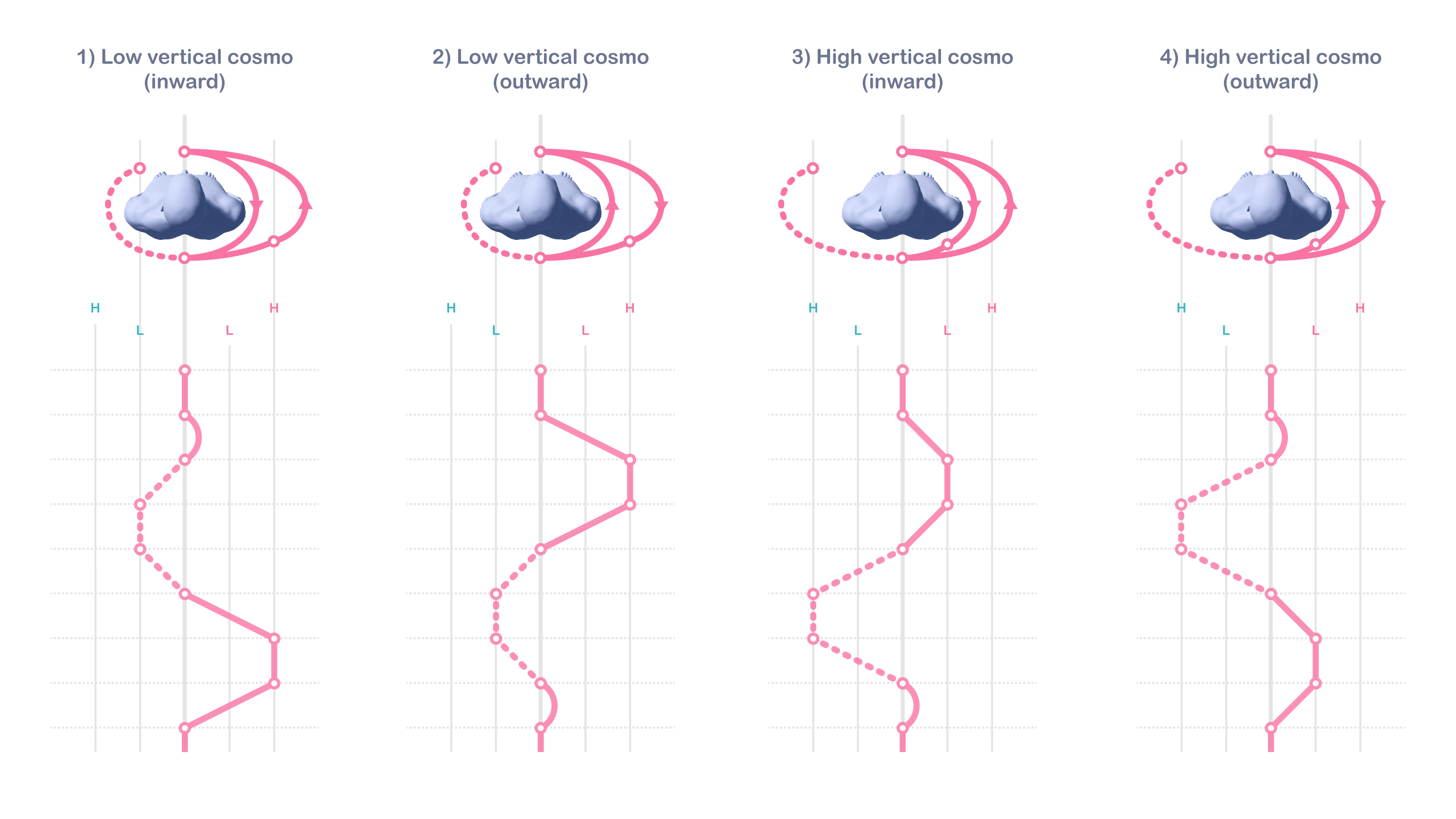
Similar to vertical wraps, the beat graphs of vertical cosmo are asymmetrical and change their appearance when the poi direction changes, so they require separate consideration.

For clarity, let’s plot the poi’s movement trajectory using the example of a lower vertical cosmo with the right hand (Fig. 45) and build its graph (Fig. 46).

<figure><img src="/files/eeijQDh5ss1XKWQbGpVq" alt="" width="375"><figcaption><p>Fig. 45. Diagram of poi movement in a single-poi vertical cosmo</p></figcaption></figure>

<figure><img src="/files/i0JATSnv2cldt3RzMIsF" alt="" width="373"><figcaption><p>Fig. 46. Projection of poi movement in a single-poi vertical cosmo<br>onto a beat graph</p></figcaption></figure>

Now, let’s examine the graphs of various vertical cosmo moves, taking into account the poi direction (Fig. 47).

<figure><img src="/files/k5HHmJT5nSqPeIXvVEF3" alt="Beat graphs of one-handed vertical cosmo (right hand) for all poi directions" width="563"><figcaption><p>Fig. 47. Beat graphs of vertical cosmo for the right hand in all directions</p></figcaption></figure>

Next, we’ll create the graphs for the timing variants of vertical cosmo using the example of opposite outward poi directions (Fig. 48).

<figure><img src="/files/HOkVPAIJkxGUmunx0Czs" alt=""><figcaption><p>Fig. 48. Beat graphs of vertical cosmo in the outward direction</p></figcaption></figure>

Similarly, we can build graphs for same-direction poi movement, in this case counterclockwise (Fig. 49).

<figure><img src="/files/MkgkBB3OKsO872EnrZRC" alt=""><figcaption><p>Fig. 49. Beat graphs of vertical cosmo in the counterclockwise direction</p></figcaption></figure>

### Section summary

* A combination of three consecutive reels without extra rotations is called cosmo.
* There are a total of 12 symmetrical positions where cosmo can be performed.
* Cosmo in any of these positions can be executed in 8 timing variants, 5 of which are unique, and 3 are mirrored copies of existing types.
* Each cosmo timing variant can be performed with 2 timing/direction combinations.
* Any cosmo can be broken down into various wraps, with timing names corresponding to the cosmo types.

## Physical limitations of the system

Despite the accuracy of the theoretical model, the physical limitations of our body sometimes impose constraints, making certain elements described in this work difficult or even impossible to perform. Perhaps the most noticeable limitation in this system relates to the Split-Same timing/direction combination. Only in the Split-Same timing/direction combination is it impossible to spin poi in the same plane from a single point—the poi will simply tangle with each other or wrap around the arms. For this reason, in a linked wrap composed of two Split-Same weaves, we cannot transition from one weave to another without extra rotations.

In the classic two-beat waist wrap, as mentioned earlier, this problem is solved with an additional poi rotation in front of the body during one of the transitions. Since this system excludes any unnecessary rotations, in its pure form, these wraps can only be performed using "workarounds" like rotations in the negative space between the arms.

This issue affects a large number of Split-Same tricks in the described system. Some can be resolved by using negative space, while others are simply impossible. Considering how popular this timing is, it might seem like a significant drawback of the system. However, I ask everyone to remember that tricks in this timing represent only a quarter of the entire variety.

Another example of physical limitations is the upper D-crossers. When the hand is in the upper back position (behind the head), it blocks the entire area above its shoulder. If we need to place the second hand above this (non-native) shoulder, we can only thread it through a narrow gap between the arm and the head. This allows us to hold the upper D-crosser but will lock one of the hands, severely limiting the ability to enter or exit the position. This is precisely why the main version of the aforementioned classic upper cosmo around the head is actually diagonal—because the front hand, in its extreme position, is placed not above but below the other hand's shoulder.

Despite many physical limitations, most elements of the system are performable, and some of the "problematic" ones can be executed using various loopholes, encouraging the search for creative approaches.

## Conclusion

In conclusion, any spinning move within the body cross can be decomposed into weaves and mills in different positions and timings. The wraps and cosmo we’ve explored cover all the main ways to combine weaves and mills. Thus, the described elements can be considered a toolkit, and understanding its components provides a comprehensive skill set for performing any possible spinning trick within the body cross.

Without a doubt, the total number of elements described in this work is incredibly vast, but we are talking about the theoretical maximum of possible variations. In practice, attempting to learn them all would be inefficient. Even the best poi spinners in the world do not master more than 10% of the system described above. However, by understanding the structure of the entire variety of body cross tricks, we can chart the most efficient path to mastering this field. Not only can this accelerate the learning of body tracing, but it can also push its boundaries even further.

Developing training programs based on this system is a subjective and creative process. Every instructor or poi enthusiast can create their own list of tricks to study, based on personal taste, teaching experience, and current trends—each approach can be interesting in its own way. That’s what I’ve done, forming my own body tracing training program largely based on this system, and I encourage other instructors to do the same.

I hope this system will help more poi spinners reach a high level more quickly, without losing time, energy, or motivation to advance poi technique to new heights yet unknown to us.

### Acknowledgements

I want to thank Roman “Rem” Anufriev for his careful review, valuable ideas, and professional advice, which significantly improved the quality of this work.

Special thanks to my wife Julia Kushnaryova for believing in me and her invaluable support in all my endeavors.

### Quick links

If you are reading on a phone, use these links to jump to the key pages:

* [Official Merch](https://antispinner-store.myshopify.com/) — BTF artworks — the best way to support the author
* [Discord](https://discord.gg/caUrXd2gFm) — BTF discussion server
* [About an author](/btf/about/ivan-mel-gorbunov.md) — bio and links.
* [Glossary](/btf/resources/glossary.md) — core terms and abbreviations.

## Appendix: Hyper

Although all the important information in this study has already been covered, I would like to mention one final missing element of this system. I have described double consecutive reel combinations (wraps) and triple combinations (cosmo), but there also exists a quadruple combination, which I have named hyper cosmo (or simply Hyper).

The positioning of the hyper is limited to a single option for each hand, so the positioning matrix will look as follows (Fig. 50).

<figure><img src="/files/HMY4jYTER6x0s4tb5orT" alt="" width="296"><figcaption><p>Fig. 50. Positioning matrix of the hyper</p></figcaption></figure>

Let’s take a closer look at the poi’s movement cycle by drawing its conditional trajectory (Fig. 51). As shown in the diagram, the hyper can be considered a vertical cosmo with an added section behind the head. We can immediately construct a beat graph, using the right hand as an example (Fig. 52). The graph is once again vertically asymmetrical, meaning that a separate set of graphs must be created for each poi direction.

<figure><img src="/files/EGk3YmjpoYmuex78Fs6s" alt="" width="375"><figcaption><p>Fig. 51. Conditional trajectory of the hyper with the right hand in the inward direction</p></figcaption></figure>

<figure><img src="/files/6xZjnv6KYJUVm7pYmV1K" alt="" width="342"><figcaption><p>Fig. 52. Beat graph of the hyper with the right hand<br>in the inward direction</p></figcaption></figure>

The hyper has a 10-step cycle, allowing us to create 10 timing variants for this move, 6 of which are unique and 4 are "mirrored" versions of some of them. For example, I will provide the graphs for opposite inward poi directions (Fig. 53) and same-direction counterclockwise movement (Fig. 54). The naming system for hyper timing is likely to be different, so I will not assign names to the timing variants here, leaving only the fractional shift values.

<figure><img src="/files/jzcROJzJ3Up1RTVBKVuc" alt=""><figcaption><p>Fig. 53. Beat graphs of the hyper in opposite inward direction</p></figcaption></figure>

<figure><img src="/files/Q3fV1fBZkElLjvU8nJSx" alt=""><figcaption><p>Fig. 54. Beat graphs of the hyper in same-direction counterclockwise</p></figcaption></figure>

This long and limited-use pattern may not be valuable for effective training programs, but it is nonetheless interesting by virtue of its existence and will surely delight those who dare to explore it.


---

# Agent Instructions: Querying This Documentation

If you need additional information that is not directly available in this page, you can query the documentation dynamically by asking a question.

Perform an HTTP GET request on the current page URL with the `ask` query parameter:

```
GET https://antispinner.gitbook.io/btf/article/body-tracing-framework.md?ask=<question>
```

The question should be specific, self-contained, and written in natural language.
The response will contain a direct answer to the question and relevant excerpts and sources from the documentation.

Use this mechanism when the answer is not explicitly present in the current page, you need clarification or additional context, or you want to retrieve related documentation sections.